
How to set up a Construction Entrance for Trackout Control
There are few industries more backlogged than construction. There are lots of reasons for it, but it’s rare to be both on time and under budget.
Two underrated factors in work delays and explosive budget growth are compliance issues and set up/tear down costs. It’s tempting to cut corners with compliance to save both time and money, but that will always come back to bite you. Additional set up and teardown time often comes from efforts to keep budget or time down elsewhere.
We’ll walk you through how to set up your construction entrance for trackout control, and how it can save you money and time in the long run. In this article, we’ll discuss these main points:
- Trackout control protects both the environment and your bottom line
- The right construction entrance setup can save significant time and labor
- You need proper sizing and maintenance for effective trackout control
- Portable trackout mats, also known as tracking pads, offer long-term efficiency across multiple projects
Why bother controlling trackout?
Before we get to step one, let’s talk about the wee elephant in the room. Why bother with trackout control at all?
Trackout control at a construction site means any number of devices and methods intended to clean vehicle wheels of dirt, mud, oils, chemicals, and other construction debris before they can be tracked out onto public roads and into shared water systems. It’s one small part of the bigger international effort on erosion control.
Controlling your trackout keeps public roads cleaner. It better maintains the property currently under construction. It preserves the integrity of local agriculture and wildlife habitats. It also maintains the purity of public water systems.
The way trackout control will hit hardest, though, is your bottom line. Improper trackout control can earn you huge fines from local, state, and national government authorities, depending on your situation. It’s not a risk worth taking.
Benefits of solid trackout control:
- Avoid fines and legal liability
- Keep our shared roads and water systems clean
- Maintain the property you’re working on
- Preserve the local environment for agriculture and wildlife
Let’s get started.
How do you set up trackout control for your construction entrance?
First, you need to choose your trackout method. There are several, and some can be used in tandem.
Traditional stabilized construction entrances require you to excavate a patch of ground, lay down mats, and then fill them with rock, stone, or gravel. This method can be cheap initially, but is time-intensive. Setup is a bear and the stone or gravel requires constant turning as trucks drive over it, as well as refilling as the material is lost. Teardown requires you to remove all the stone or gravel and refill the excavation. It’s also pretty ugly, start to finish.
Wheel washing systems involve an elevated platform where vehicles are cleaned up before leaving the site. High-velocity side and bottom water sprayers help remove mud in hard to reach areas. The sprayers are controlled by programmable controls and sensors, which trigger appropriate water output for each truck that goes through the system. Washing systems are often combined with another method of trackout control.
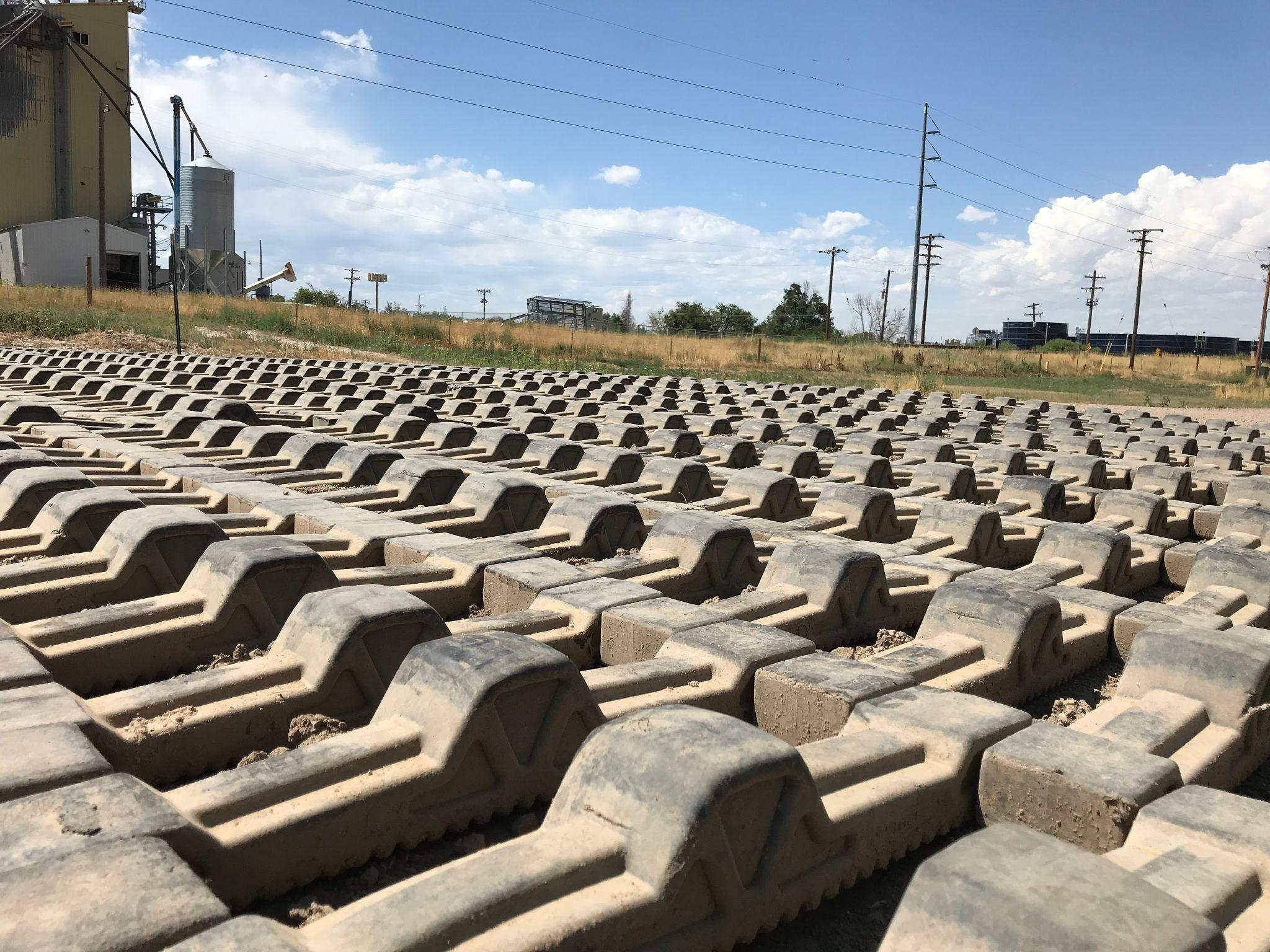
Portable trackout mats can be a very helpful alternative to traditional trackout methods. These mats are laid down at a construction entrance to serve the same purpose as the gravel or stone of the stabilized entrance: dislodge as much dirt, mud, and debris as possible from any wheels passing over them. Their advantage is in their easy portability and reusability over the traditional method. They vary in durability and ease of maintenance.
What size entrance do you need?
You’ll have practical limitations on the width of your construction entrance. Your project engineer should be able to calculate the total length needed, based on the size of vehicle tires involved and how many total rotations those tires will need to optimally dislodge all dirt, mud, and debris.
For a traditional stabilized entrance, this will obviously determine the size of excavation you need to do as well as the amount of stone or gravel needed to fill it. For a portable trackout mat, the total size needed can be fit by combining multiple mats together end-to-end and side-by-side. Depending on the type of mat, you may need to use chains or brackets to hold them together.
How do you maintain your construction entrance?
Now that your trackout control method is installed and working, you need to maintain it.
For traditional stabilized construction entrances, this means constantly turning over the stone or gravel as it gets covered in dirt or mud and compacted down. As you lose stone or gravel from the setup, you’ll need to replace them with fresh ones.
Portable trackout mats require less maintenance. There’s nothing to “refill” periodically. They do need to have the accumulated mud and debris cleaned out from time to time. Some mats require a special tool to clean out the space between their “teeth.” Our RubberForm trackout mats can just be raised up, shaken out, then laid back down.
How do you tear down your construction entrance?
There’s no better feeling than a job well done. Particularly the “done” part. Now that the construction is finished, how demanding is tear-down?
For a traditional stabilized construction entrance, you’ll need to clean up all the excess stone and gravel. The stone mat area you excavated will need to be filled back in or covered over. It’ll take some time.
For trackout control mats, all you’ll need to do is clean them (as covered above) and then fold them up. They’ll be available again for the next job site. Fewer headaches for you and minimal fuss for your team.
Why use RubberForm trackout control mats?
RubberForm tracking pads are the toughest, easiest-to-use pads on the planet.
For our mats, we innovated a unique composite material from 100% American recycled rubber and plastic that won’t chip, crack, crumble, or corrode in any heat, cold, or heavy vehicle traffic.
Setup is simple:
- Lift the mat
- Lay it out
- Get to work
We’re not kidding. Setup takes just a few minutes, and you won’t need any additional brackets or chains to keep the pads in place. Cleaning is easy too: just lift, shake them out, and lay them back down.
When the job is done, fold the mat into its compact z-fold shape and store until the next job. Our tracking pads are built to last years, and are fully modular. That means if you do somehow manage to break a block, it can be individually replaced. You can reuse our pads at job after job with minimal maintenance.
What now?
Construction is a tough enough job already. Proper construction safety makes it even harder. At the very least, setting up, maintaining, and tearing down your construction entrance mat system should be easy.
When you’re ready to use the world’s strongest, simplest trackout mats, give us a call. We’d love to help.
Date Published: March 23, 2026