
The best speed bump matches your traffic burden, surface material, and how permanent you need it to be. For most parking lots and private roads, a portable recycled-rubber speed bump is the strongest all-round choice: it slows traffic as effectively as asphalt or concrete, installs in minutes without heavy equipment or large crews, and can be moved or removed as your needs change.
This guide covers what separates a good speed bump from a poor one, when portable rubber beats permanent asphalt or concrete, and which RubberForm® models fit which situations. If you are still deciding between a speed bump, a speed hump, or another traffic calming device, start with our guide to choosing speed bumps and speed humps and the difference between speed bumps and speed humps, then come back here to pick a product.
Key Takeaways
- The best speed bump matches your traffic speed, surface type, and permanence needs.
- Speed bumps, humps, tables, and cushions are distinct devices built for different target speeds.
- Portable rubber speed bumps calm traffic on asphalt or concrete and are much easier to install and remove.
- Rubber bumps made from recycled composite resist chipping, cracking, and corrosion in any weather.
- RubberForm® offers models for parking lots, streets, high-weight traffic, and unpaved roads.
What Makes a Speed Bump “the Best”?
“Best” may be in the eye of the beholder but we think matching four important factors comes pretty darn close. Judge any option against these before you buy:
- Traffic speed target. Different speed bumps/humps/cushions/tables are built for different speeds. A parking lot speed bump slowing cars to 5 mph is a different device from a speed hump on a through-road.
- Surface. Asphalt, concrete, gravel, and dirt each can need different anchoring systems. A bump that cannot be secured to your surface will not last permanently.
- Permanence. If you need to move, remove, or store the bump seasonally, a portable model matters. If it will never move, it matters less.
- Durability. Weather, UV, and heavy traffic break down cheap materials. Recycled rubber composite holds up where asphalt and concrete chip and crack.
Types of Speed Bumps
“Speed bump” is often used as a catch-all, but several distinct types of vertical traffic-calming devices exist, and they are built for different speeds and settings. Knowing the type you need comes before choosing a material or model.
- Speed bump. The most aggressive. A short, raised device (usually 3 to 6 inches high over a 1 to 3 foot span) that forces vehicles down to 2 to 5 mph. Best for parking lots, driveways, and private roads in which traffic should nearly stop.
- Speed hump. Gentler and wider (10 to 14 feet across), designed to slow traffic to 10 to 15 mph without the sharp jerk of a bump. Common on residential streets.
- Speed table. A flat-topped, longer raised section, often used at pedestrian crossings so a whole crosswalk sits at the raised height.
- Speed cushion. A bump with wheel gaps that let wide-axle emergency vehicles pass at speed while slowing standard cars. Used on routes fire trucks and ambulances travel.
- Rumble strips. Not a bump at all, but grooved or raised strips that alert drivers through sound and vibration rather than forcing a slowdown.
Speed bumps also vary by height and profile (a 2.5″ bump slows traffic less abruptly than a 3″ or 4″ bump) and by material (recycled rubber, asphalt, concrete, plastic, and metal). Rubber and the other materials are compared below.
If your real question is which device to use rather than which product to buy, our guide to choosing speed bumps and speed humps and the difference between speed bumps and speed humps walks through the decision in depth.
Why Portable Rubber Beats Permanent Asphalt or Concrete
For most properties, portable rubber wins on everything except the fact that it can be moved (and being movable is itself an advantage). Permanent asphalt or concrete bumps calm traffic, but they break down over time the same way your lot surface does, and you can’t relocate them without time- and money-intensive demolition.
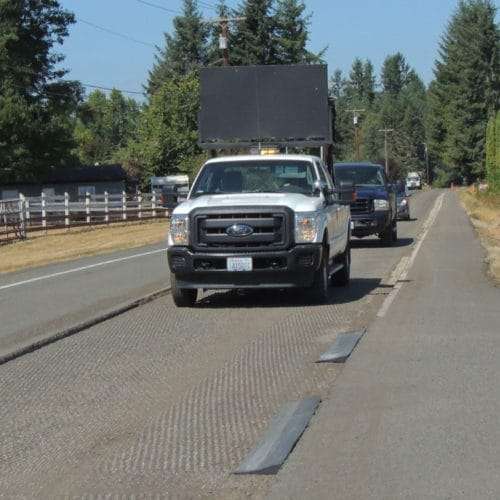
Recycled rubber speed bumps calm traffic just as effectively and add flexibility. A single worker can deploy a rubber bump across a lane in minutes with no heavy equipment, large crews, or road closures. You can install speed bumps in spring and pull them before winter, so plows run clean. For portable speed bumps (like our MLSB), you can set them out only for school drop-off and pickup and leave the lot open the rest of the day. When you repaint or re-stripe the lot, portable bumps move to the new layout instead of forcing demolition and reinstallation.
Cost follows the same pattern. Permanent bumps carry construction and supply costs upfront; portable bumps cost far less to buy and install, and a recycled composite model lasts years without chipping, cracking, corroding, or crumbling in heat, cold, or heavy traffic.
Rubber vs. Asphalt vs. Concrete Speed Bumps
Here is the side-by-side. Rubber wins on nearly everything that matters for a private lot or road; asphalt and concrete only pull ahead in narrow permanent-install cases.
| Factor | Rubber (portable) | Asphalt | Concrete |
|---|---|---|---|
| Upfront cost | Low to moderate | Moderate (construction) | Higher (construction) |
| Installation | Minutes, one person, no heavy equipment | Crew + paving equipment | Crew + forming/pouring |
| Movable / removable | Yes | No | No |
| Durability | Will not chip, crack, or corrode | Cracks, potholes over time | Cracks, spalls over time |
| Surface fit | Asphalt, concrete, gravel, dirt | Paved only | Paved only |
| Seasonal removal (snow/plowing) | Yes | No | No |
| Reconfiguring the lot | Relocate | Demolition | Demolition |
When asphalt or concrete still make sense: a permanent installation on a public road that will never be reconfigured, high-volume municipal traffic where a fixed cast bump is specified, or a setting where an existing spec or ordinance calls for asphalt or concrete specifically. For most private lots, campuses, and roads that favor flexibility and lower install cost, portable rubber is the stronger long-term choice.
Benefits of Portable Speed Bumps
Portable speed bumps deliver five things a permanent bump cannot match all at once:
- Reduce speeding. Placed at the right spots, they give drivers a physical cue to slow down where signs alone fail. RubberForm® models bring speeds under 10 mph, or down to 5 mph.
- Improve safety. NSC analysis of government data shows parking lots and garages see tens of thousands of accidents a year. Slower speeds give drivers time to see and react to pedestrians and to pull in and out of spots safely.
- Install, remove, and relocate easily—no construction or pavement alteration. Set them without heavy equipment or lot closures, and move them as traffic patterns change.
- Cost-effective. Lower purchase and installation costs than permanent bumps, and years of service life with basic maintenance.
- Better traffic control. Beyond speed, they keep cars, pedestrians, and cyclists in their intended lanes, and can be repositioned for major events that change the ideal flow.
The RubberForm® Speed Bump Lineup
RubberForm® makes several recycled-rubber speed bumps, each made to a different situation. Match the model to your traffic and surface.
MLSB (Modular Lane Speed Bump). The most flexible option. Sections connect like puzzle pieces with a dovetail design for any length you need, and they can sit straight on pavement with no bolting, drilling, or adhesive for temporary use, or be anchored for permanent installation. The MLSB 2.5″ targets speeds under 10 mph; the 3″ and 4″ slow aggressive traffic to 3 to 5 mph and suit construction sites. The 4″ is built for high-weight vehicles and is not recommended for pedestrian or normal vehicle use. See the MLSB line.
SB-10. Easy to deploy, install, and recover, with optional center modules for custom lengths. A good fit for streets and main residential roads where you want to raise pedestrian safety in high-volume traffic areas, and simple enough to pull seasonally before snow. See the SB-10.
Dirt Road Speed Bumps. Unpaved roads need anchoring that pavement bolts cannot provide. These pair the speed bump with a specially designed earth-anchor screw that secures to dirt and gravel. See the dirt road speed bumps.
Which Speed Bump Should You Choose?
Match the model to your situation:
- Parking lot, cars under 10 mph: MLSB 2.5″, a low profile that connects to any length and lays down without anchoring for temporary use.
- Construction site or aggressive traffic (3 to 5 mph): MLSB 3″ or 4″, a taller profile for a firmer slowdown. Use the 4″ only for high-weight vehicles, not pedestrian or normal vehicle areas.
- Residential or main street: SB-10, easy to deploy and recover, with center modules for custom lengths.
- Gravel or dirt road: Dirt Road Speed Bumps, with earth-anchor screws that secure to unpaved surfaces.
- Temporary or seasonal use anywhere: any MLSB. Lay it down, connect the sections, pick it up when you are done.
Where to Place Speed Bumps
Placement decides whether a speed bump works or annoys drivers. A few guidelines:
- Put bumps where speeds actually climb: long straightaways, lot entrances and exits, and approaches to pedestrian crossings.
- Give drivers clear sightlines to each bump. A bump hidden around a blind corner causes hard braking instead of a smooth slowdown, and reflectors help drivers spot them early.
- Space multiple bumps evenly so drivers stay slow across the whole stretch rather than speeding up between them.
- Avoid placing bumps directly on sharp turns, at the bottom of steep grades, or where emergency vehicles need an unobstructed path.
For spacing specific to your speed target and traffic volume, your site plan or a traffic engineer is the right reference.
Not Sure a Speed Bump Is the Right Device?
A speed bump is one of several traffic calming options, and it is not always the best fit. Speed humps, speed cushions, and speed tables each slow traffic differently and fit different speed targets and vehicle types. If you are choosing the device itself rather than a product, start with our guide to choosing speed bumps and speed humps and the difference between speed bumps and speed humps, then come back to pick the model.
Why Buy RubberForm® Speed Bumps
RubberForm® speed bumps are made from 100% recycled rubber and plastic composite, built to resist extreme temperatures, constant UV, and high traffic volume without chipping, cracking, crumbling, or corroding. They install easily, last for years, and are manufactured in the USA from domestically-sourced recycled materials.
When you are ready to find the right speed bump for your property, call us or send a message. We’d love to talk you through the options!
Date Published: August 25, 2021